


Common Mistakes That Make Your Bedroom Feel Stressful
A practical look at the everyday bedroom choices — lighting, clutter, stray furniture, habits — that quietly raise stress levels, with simple fixes you can make this week.
You spend roughly a third of your life in one room, and yet it is often the last room in the house to get any real attention. The kitchen gets planned, the living room gets rearranged, the hallway gets a coat of paint. The bedroom gets whatever is left over: the old chair, the boxes that don't fit anywhere else, the laundry that hasn't been folded since Tuesday. Then you wonder why you lie there at eleven o'clock feeling wired.
Stress in a bedroom rarely comes from one dramatic problem. It comes from a collection of small, reasonable decisions that add up — the laptop on the nightstand, the overhead light you can only switch fully on or fully off, the pile of paperwork on the floor that you've stopped seeing. None of these things is a disaster. Together, they turn a place of rest into a place of unfinished business. The good news is that most of them are easy to correct.
Letting One Room Do Too Many Jobs
The most common mistake is expecting the bedroom to be an office, a gym, a laundry, a cinema and a storage unit at the same time. Every object carries an instruction with it. A stack of invoices says deal with me. A treadmill draped in clothes says you should be using this. A laptop on the duvet says one more email. Your brain reads those instructions even when you're trying to switch off, and that low hum of obligation is exactly what makes a room feel tense.
Be honest about which jobs genuinely need to happen in this room. If you have nowhere else to work, keep the desk but give it a clear boundary: a physical one if possible, such as a folding screen or a tall plant, and a time-based one at the end of the day. Close the laptop, put the papers in a drawer, cover the monitor. If exercise equipment lives in the bedroom, at least give it a dedicated corner with a mat rolled up underneath it rather than letting it sprawl.
If an object reminds you of a task every time you look at it, it either needs a home out of sight or a home in another room.
Lighting That Works Against Sleep
A single bright ceiling light is the most reliable way to make a bedroom feel like a waiting room. It's harsh from above, it casts shadows under your eyes, and it has only one setting: full daylight. You need the opposite — light that can come down low and warm as the evening goes on.
Aim for three layers
- Ceiling light: keep it, but put it on a dimmer or use a warm bulb. Save it for cleaning and getting dressed.
- Bedside light: two, ideally, so nobody has to read in a spotlight while the other person sleeps.
- Low light: a small lamp on a chest of drawers or a warm floor light angled at a wall. This is the light you use in the last hour before bed.
Bulb colour matters more than people expect. Warm white — the sort labelled around 2700K — reads as evening. Cool, bluish light reads as midday and makes it harder to feel sleepy. Also check the curtains: thin fabric lets in street lights and an early sunrise, and a decent blackout lining is one of the cheapest upgrades in the room. Just make sure you can open it easily in the morning, because daylight when you wake helps set your body clock.
Treating Surfaces as Storage
Nightstands, dresser tops and the chair in the corner are not storage. They are places where things land. Left alone for a fortnight, each one becomes a small archaeological site of receipts, hair ties, half-empty glasses and chargers.
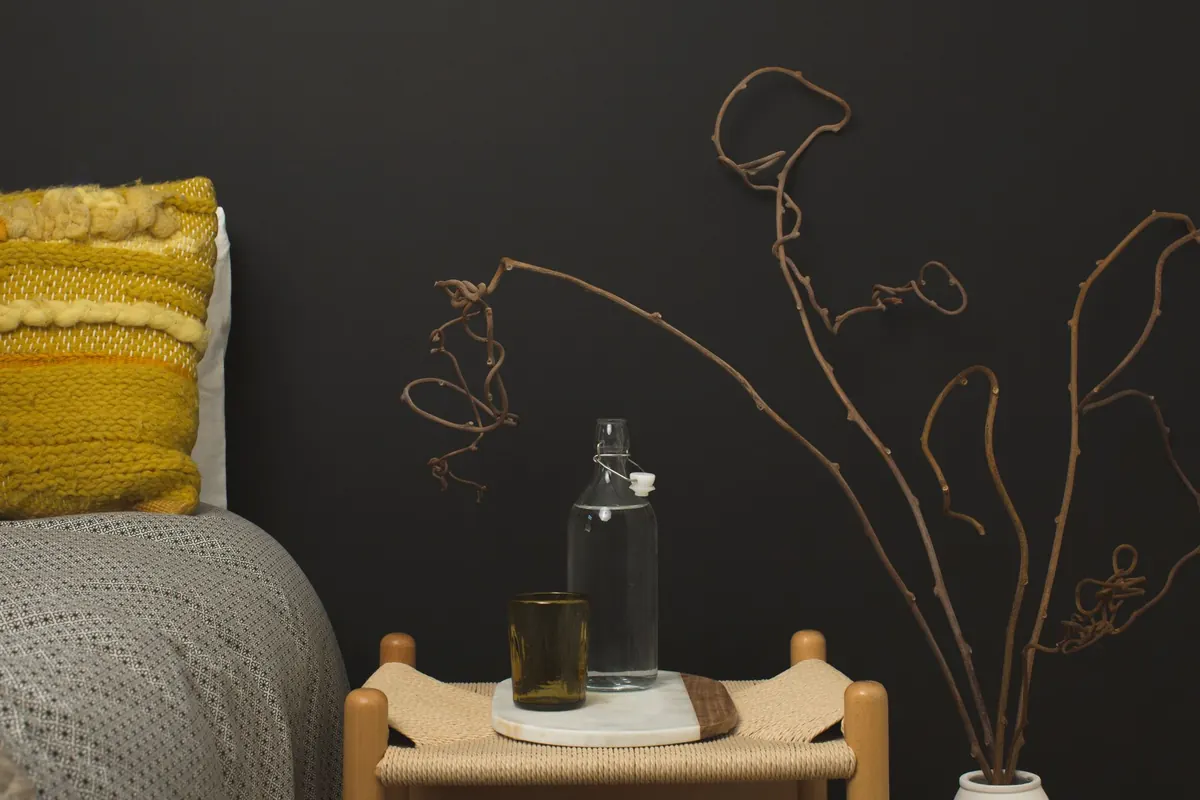
The most useful rule I know is a number: keep each surface to three or five things. A lamp, a book, a glass of water — done. Anything else needs a drawer, a basket or a bin. For the chair that has become a wardrobe, decide in advance whether it's allowed to hold clothes at all. If it is, keep it to items you'll genuinely wear again tomorrow, hanging or folded rather than heaped. If it isn't, the chair moves out.
Under-bed space needs the same discipline. Boxes are fine; a loose jumble of shoes, wrapping paper and old bedding is not, because you can feel it in the room even when you can't see it. Closed, labelled storage solves this in an afternoon.
Bringing Work and Screens Into Bed
The bed should mean one thing. When you answer emails, scroll, eat toast and argue about bills in it, you train yourself to feel alert the moment you get in. It sounds small. It isn't.
Try a strict separation for two weeks. Work happens at a table, not propped on pillows. Food stays in the kitchen, because crumbs and coffee cups don't help anyone settle. And the phone charges across the room, or better, outside it — buying a cheap alarm clock is a genuine improvement to a bedroom. If you read on your phone at night, switch to a paper book for the last half hour and notice the difference.
Ignoring Temperature, Air and Noise
You can style a room beautifully and still sleep badly in it. Three invisible factors do more for restfulness than any cushion arrangement.
Temperature. Most people sleep better in a slightly cool room than a warm one, so layer bedding rather than overheating the whole space. Air. A bedroom that's been shut all day smells stale and feels heavy; open a window for ten minutes before bed, even in winter. Noise. A ticking clock, a buzzing charger, a dripping tap, a door that rattles in the draught — these are small sounds that keep pulling you back towards the surface of sleep. Walk into the room with the lights off and just listen. You'll be surprised what you've stopped hearing.
If you've addressed the obvious things and still struggle to sleep most nights, that's worth raising with a doctor rather than solving with another cushion.
Too Much Visual Noise
Patterned wallpaper, busy bedding, a gallery wall, three rugs and a boldly painted ceiling can all be lovely — just not usually all in one small room. Visual noise keeps the eye moving, and a room where the eye never rests rarely feels calm.
Pick two or three colours and let the bedding be quiet. Solid or simply textured duvets tend to feel calmer than large florals, especially under a patterned headboard. Hide cables where you can: a strip of Velcro, a cable box or simply routing them behind the furniture makes an astonishing difference. Avoid stacking open shelving with small objects directly opposite the bed; when you can't sleep, that's exactly where your gaze goes.
A Ten-Minute Evening Reset
Rather than a big weekend overhaul, try a short routine that keeps the room from drifting back into chaos. It works best done at the same time each night, before you're tired.
- Clear the nightstand and dresser tops back to their agreed few items.
- Put stray clothes away or in the laundry basket — nowhere else.
- Close the laptop, cover the desk, put papers in a drawer.
- Switch off the ceiling light and turn on the low lamp.
- Open the window for a few minutes, then close it.
- Plug the phone in away from the bed and set the alarm.
Ten minutes, six steps, and the room tells you something different when you walk into it: nothing here needs doing. That's the whole goal. A restful bedroom isn't the most decorated one — it's the one that asks the least of you at the end of the day.
Photo: Burst / Pexels